

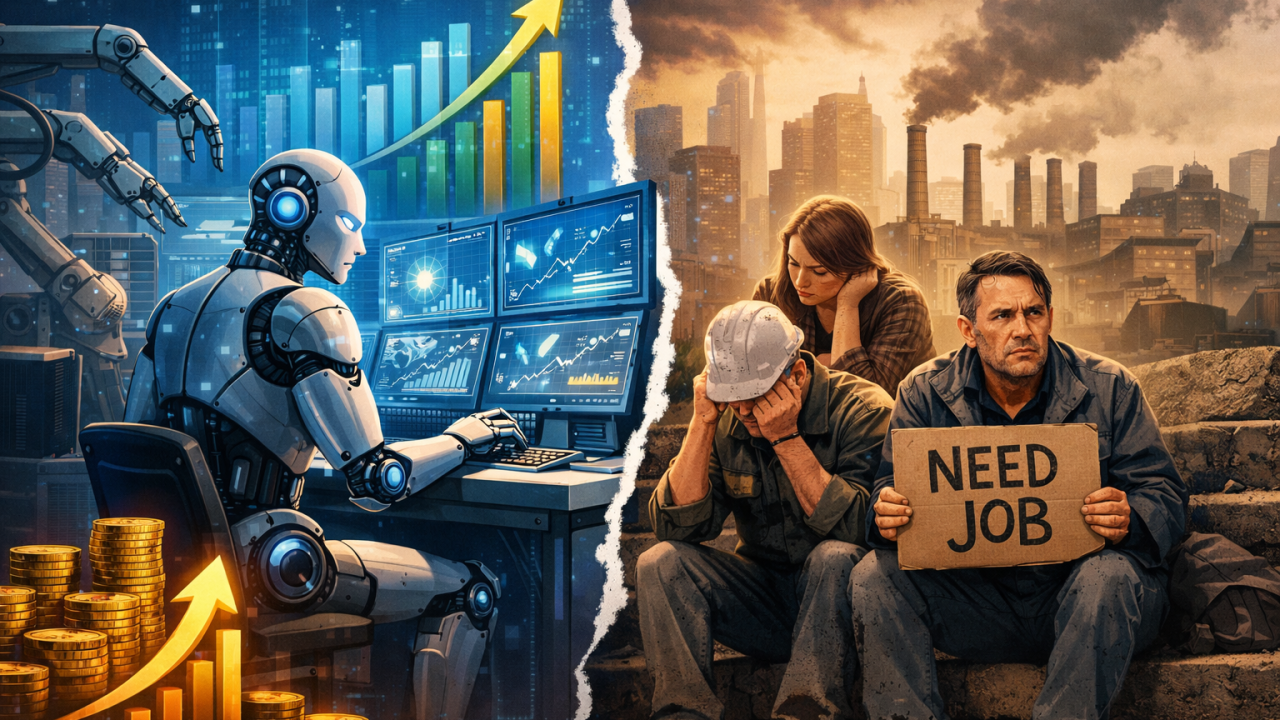
“Shocking Math” Claims AI Could Replace Jobs and Disrupt the Global Economy
A viral analysis and ongoing debate in tech and economics circles is once again raising alarm about the future of work, with claims that accelerating artificial intelligence adoption could reshape labour markets on an unprecedented scale.
The discussion, often framed as “shocking math,” suggests that if AI systems continue improving at their current pace, large portions of today’s jobs—especially white-collar and digital work—could become fully or partially automated, potentially destabilizing traditional employment structures and economic models.
Experts and research institutions agree that AI is already transforming labour markets, but they differ on the scale and speed of disruption. Studies from organizations such as the International Labour Organization (ILO) and the World Bank indicate that generative AI will reshape jobs globally, with developing countries potentially facing faster disruption due to digital gaps and structural weaknesses in their economies.
At the same time, global financial bodies like the International Monetary Fund (IMF) have warned policymakers to prepare for significant labour market shocks caused by AI, comparing its impact to previous waves of globalization that reshaped entire industries and displaced large segments of workers.
However, not all analysts agree with the most extreme predictions. Some studies suggest that AI adoption is currently more focused on improving productivity rather than directly eliminating jobs, with many companies using automation to support workers rather than fully replace them.
READ MORE: Israeli Finance Minister Renews Call to Destroy Beirut Buildings After Rocket Attacks
Tech researchers also emphasize that most current AI impact is occurring at the task level rather than full job replacement, meaning roles are being reshaped rather than entirely eliminated. This distinction is central to ongoing debates about whether AI will cause mass unemployment or a gradual transformation of work.
Despite differing opinions, there is broad consensus that entry-level white-collar jobs, outsourcing roles, and routine digital tasks are among the most exposed to automation. This is already leading to changes in hiring patterns, especially in tech-driven economies.
As AI adoption continues to expand globally, economists argue that the real challenge will not only be technological—but also social and policy-driven, as governments and industries attempt to balance productivity gains with employment stability.
For now, the “shocking math” remains more of a warning model than a proven outcome—but one that policymakers and businesses are increasingly taking seriously.