

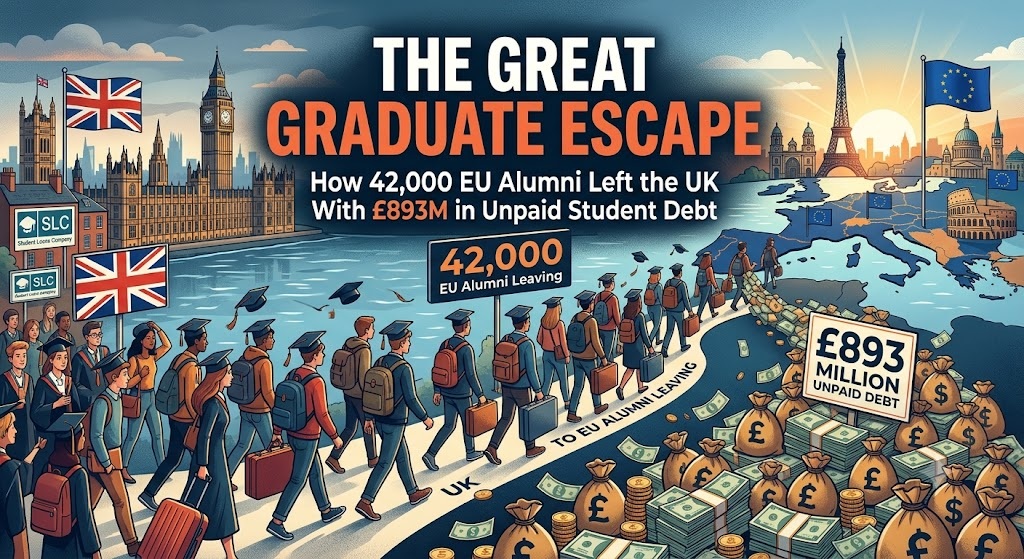
The UK higher education system is facing a massive fiscal hemorrhage as recent data reveals that over 42,000 European Union citizens who graduated from British universities have effectively “fled” back to the continent or moved overseas, leaving behind a staggering £893 million in unpaid student loans.
The crisis underscores growing friction within the Student Loans Company (SLC) and HM Revenue and Customs (HMRC), which are struggling to track and collect debts once a borrower leaves the British tax system. While domestic UK graduates have their repayments automatically deducted from their paychecks via the PAYE (Pay As You Earn) system, overseas collection relies almost entirely on self-reporting—a loophole that tens of thousands of EU nationals are actively exploiting.
The Breakdown of a Billion-Pound Black Hole
Prior to the post-Brexit transition taking full effect for new enrollments, EU students enjoyed the same home-fee status and access to taxpayer-backed tuition fee loans as domestic British students. However, keeping tabs on these borrowers after graduation has proven to be an administrative nightmare.
According to government watchdogs and recent parliamentary inquiries, the outstanding debt from EU borrowers has grown aggressively. Official figures show that out of the cohort liable to repay, an alarming percentage have either provided no verified earnings information or have fallen heavily into arrears.
| Metric | Details |
| Total Non-Repaying EU Graduates | ~42,000 individuals |
| Estimated Outstanding Unpaid Debt | £893 Million |
| Primary System Vulnerability | Reliance on voluntary overseas income self-assessment |
| Average Repayment Trigger | 9% of income over varying regional thresholds |
The Student Loans Company uses a system of regional thresholds calculated against the local cost of living to determine how much an overseas graduate should pay. For instance, recent adjustments by Chancellor Rachel Reeves have squeezed graduates living in countries like Germany and Belgium by slashing the local repayment threshold down to £23,510—meaning people face massive repayment hikes even without a salary increase. Ironically, this aggressive tightening appears to have backfired, incentivizing hard-pressed graduates to drop off the grid entirely.
Also Read:
UK Considers Tough New Online Safety Rules to Stop Children From Contacting Strangers
A Game of Hide-and-Seek Across Borders
“Once an EU graduate leaves the UK, the mechanisms for enforcement drop off a cliff,” explains Dr. Aris Georgopoulos, an institutional economist specializing in public funding.
“If a borrower moves back to France, Spain, or Poland and simply ignores the letters from the SLC, the legal recourse for the UK government to recover that debt across international borders is incredibly cumbersome, expensive, and rarely enforced. For many, it’s a calculated risk: ignore the emails, build a life back home, and let the 30-year or 40-year write-off clock tick down.”
Under the standard UK Student Loan Rules, any borrower leaving the UK for more than three months is legally required to fill out an Overseas Income Assessment form. Failure to do so results in the SLC applying punitive “non-compliance” interest rates and building up arbitrary arrears. But for graduates with no intention of ever returning to work in the UK, these penalty balances are viewed as monopoly money.
The Taxpayer Backlash
The revelation of the £893 million black hole comes at a time of deep domestic frustration regarding university funding. British students are graduating with average debts exceeding £45,000, facing high interest rates, and navigating a job market where the median graduate salary hovers around £42,000.
Critics argue that the UK taxpayer is effectively subsidizing the higher education of foreign nationals who take their high-level skills, degrees, and economic potential back to their home countries without contributing a penny back to the system that trained them.
The Government has stated it is looking into “more robust data-sharing agreements” with international tax authorities to plug the leak, but tracing individuals across global jurisdictions remains a slow-moving process. For now, the £893 million vanishing act remains one of the costliest unintended systemic legacies of the pre-Brexit university funding model.