
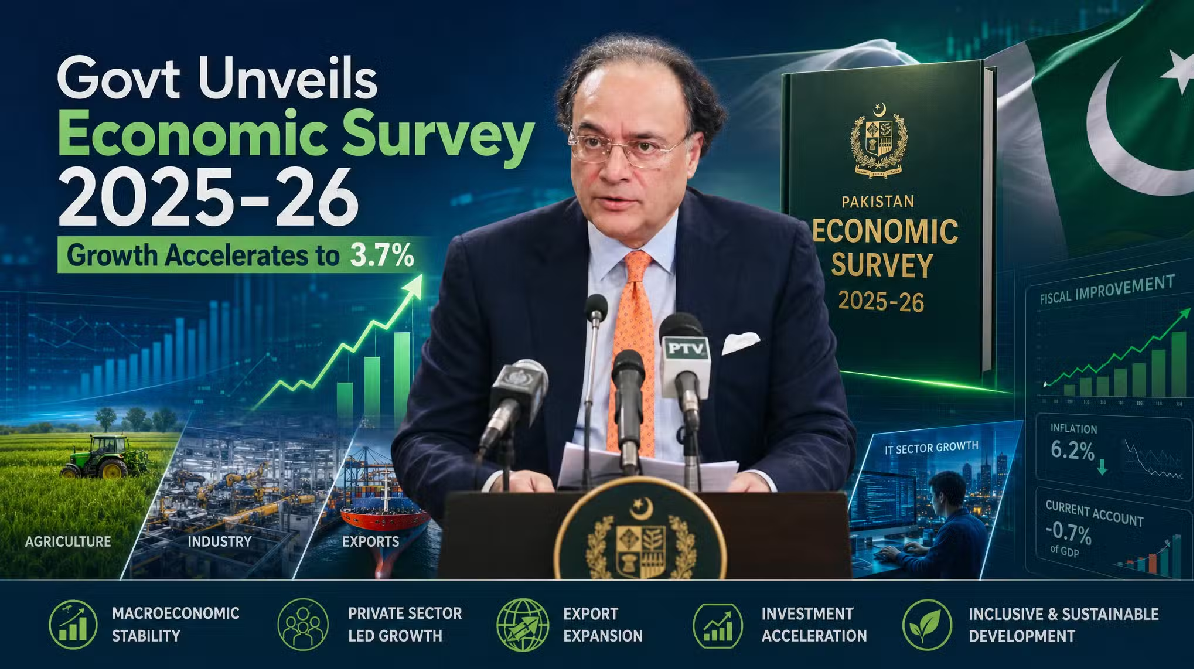
The Government of Pakistan has released the Economic Survey 2025-26, presenting a comprehensive overview of the country’s economic performance ahead of the federal budget. The report highlights improving macroeconomic indicators, stronger fiscal stability, and gradual recovery across key sectors despite ongoing domestic and global challenges.
According to the survey, Pakistan’s economy recorded a provisional GDP growth rate of 3.7 percent during FY2025-26. While the figure remained below the government’s original target of 4.2 percent, it reflects a notable improvement compared to previous years and signals a continued path toward economic stabilization. Finance Minister Muhammad Aurangzeb described the fiscal year as one marked by resilience despite external shocks, including global trade uncertainties, climate-related disruptions, and regional geopolitical tensions.
The survey indicates that the overall size of Pakistan’s economy expanded significantly, reaching approximately Rs126.9 trillion. In dollar terms, the economy grew to more than $452 billion, while per capita income increased to around $1,900, demonstrating gradual improvements in economic activity and income levels.
The services sector emerged as the primary driver of growth during the outgoing fiscal year, outperforming several other segments of the economy. Industries related to education, healthcare, information technology, telecommunications, and financial services recorded encouraging growth rates. The health and social services sector particularly exceeded expectations, reflecting increased investment and activity in public welfare initiatives.
READ MORE: Can Your iPhone Run the New AI Siri? Here’s the Complete List of Supported Devices
However, the agriculture sector delivered a mixed performance, falling short of anticipated targets due to weather-related challenges and lower output in some major crops. Manufacturing also faced obstacles linked to energy costs, input prices, and fluctuating demand, although signs of recovery were visible in selected industries.
The survey further highlights improvements in inflation management and external sector stability. Policymakers pointed to controlled inflation trends, stronger foreign exchange reserves, and improved investor confidence as positive indicators supporting economic recovery. The government also emphasized ongoing reforms under its economic stabilization framework and collaboration with international financial institutions.
Looking ahead, authorities remain optimistic about sustaining economic momentum during the next fiscal year. Planned reforms, increased investment opportunities, export promotion measures, and digital transformation initiatives are expected to play a central role in accelerating growth and enhancing competitiveness.
The Economic Survey serves as a key policy document that lays the groundwork for the upcoming federal budget and provides insight into the government’s economic priorities for FY2026-27. As Pakistan navigates a challenging global environment, the report suggests that the country is gradually moving toward greater macroeconomic stability and long-term growth prospects.